I got my auto insurance renewal last month and I actually called my agent to confirm it was correct. $2,180 for six months. That is $363 a month. For a 2019 Honda Accord. With a clean driving record. No accidents. No tickets. Just... living in Denver in 2026.
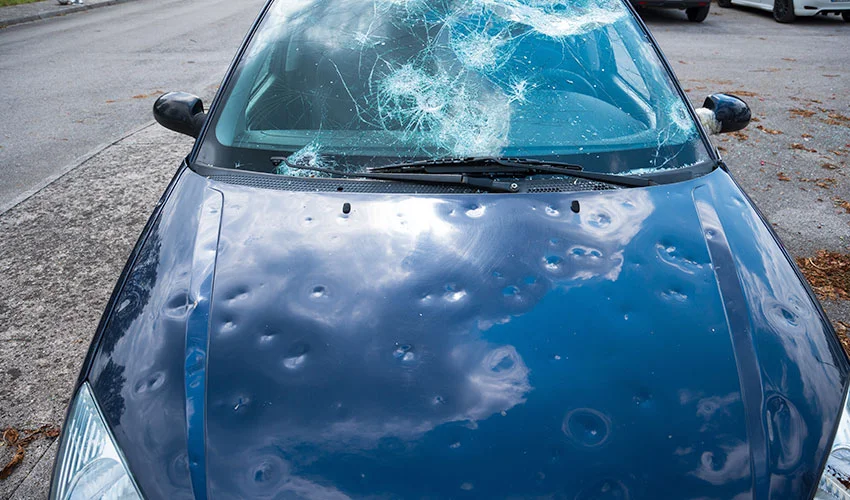
The reason? Hail. Again. Colorado had another brutal hail season. $2.3 billion in auto claims. And insurance companies are passing every penny to policyholders. My comprehensive deductible went from $500 to $1,000. My premium went up 34%. And I did not even file a claim.
I shopped around. Three quotes. All higher than my current rate. One company — a major national brand — would not even quote me. "We are not writing new comprehensive coverage in Denver zip codes," they said. They had pulled out entirely. The market is hardening, and consumers are paying the price.
My agent suggested I drop comprehensive coverage. "Your car is worth $14,000," he said. "A $1,000 deductible plus the premium might not be worth it." I did the math. $2,180 a year for comprehensive and collision. Over five years, that is $10,900. If my car gets totaled by hail, I get $13,000 minus $1,000 deductible. So $12,000. Minus the $10,900 I paid in premiums. Net benefit: $1,100. Over five years. That is $220 a year in actual protection. For a car I need to commute.
I kept the coverage. Because $220 a year in protection is still protection. And because I cannot afford to replace a $14,000 car out of pocket. But I raised my deductible to $1,500. That dropped my premium to $1,840. A $340 savings. I put that $340 in a separate account. My "hail fund." If I need it, I have it. If I do not, I keep saving.
If you live in Colorado, check your auto insurance. Check your comprehensive deductible. Check if your company is still writing new policies in your zip code. And consider whether a higher deductible makes sense. Because $363 a month is not sustainable. And neither is hoping the hail misses your car.
I also looked into usage-based insurance. The kind where a device in your car tracks your driving and adjusts your rate accordingly. I drive 8,000 miles a year. Mostly highway. No hard braking. No late-night driving. The quote? $1,420 for six months. Still high, but $760 less than my current renewal. That is real savings. And it is based on my actual behavior, not my zip code's hail history.
But usage-based insurance has privacy concerns. The device tracks location, speed, acceleration, and braking. The insurance company knows where you go, when you go, and how fast you get there. For $760 in savings, I am willing to trade some privacy. Not everyone is. And in Colorado, where hail is the primary driver of rates, even perfect driving might not save you if a storm totals your car.
I also learned that garage parking matters. My neighbor parks on the street. His comprehensive rate is 15% higher than mine because his car is exposed to hail. I park in a garage. That 15% difference is $327 a year. Over five years, that is $1,635. The garage cost me nothing extra — it came with my apartment. But if you are choosing between apartments, garage parking might be worth more than you think. Especially in Denver. Especially in 2026.
I also looked at dropping collision coverage entirely. My car is worth $14,000. A major accident would total it. But I have $8,000 in savings. If I drop collision, I save $680 a year. Over five years, that is $3,400. If I have one accident in five years, I am out $14,000 minus whatever the other driver's insurance pays. It is a gamble. And I am not sure I want to take it. But the math is tempting.
The reality is that Colorado auto insurance in 2026 is a mess. Hail, theft, rising repair costs, and legal environment all push rates up. And consumers are caught in the middle. We need cars. We need insurance. And we cannot afford what the market is charging. Something has to give. Either rates come down, or more people drive uninsured, or the state steps in with regulation. I am not holding my breath for any of those.
— Marcus Tiernan, Denver, CO
Marcus is an insurance veteran who now pays the same high rates he used to sell. He believes in shopping around and understanding what you are actually buying.
