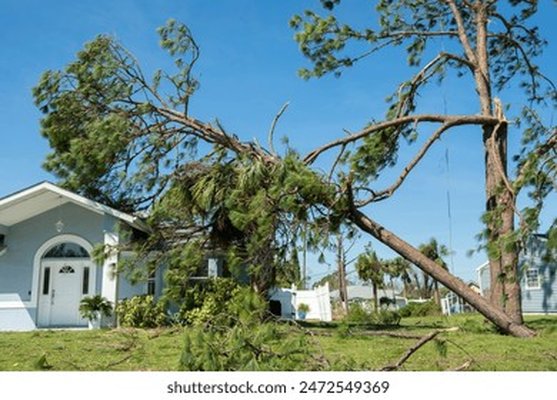
Reinsurance rates are up about 30% after last year's hurricane season...
I was on a call last month with a former colleague who still works in commercial underwriting. He told me something that kept me up that night. He said “Marcus, we’re seeing reinsurance renewals at about 30-40% higher than last year. Some layers are up 50%. And it’s not just coastal. It’s everywhere.”
Reinsurance is insurance for insurance companies. When a big storm hits, the primary insurer pays claims up to a certain limit, say $10 million. Then the reinsurer pays the next layer, say from $10 million to $50 million. This system spreads risk so one hurricane doesn’t bankrupt a regional carrier. But after several years of catastrophic losses – hurricanes, wildfires, hailstorms, floods – the global reinsurance market has hardened. They’re charging more, offering less capacity, and pulling out of high-risk regions altogether.
That cost gets passed down to you.
I remember a family in the southwest suburbs – let’s call them the Davises. They had a nice split-level, no claims in ten years. Their homeowners premium was around $1,100 in 2023. In 2024, it went to about $1,350. In 2025, roughly $1,700. Their 2026 renewal came in at about $2,200. No claims. No changes to the house. The agent’s explanation: “Reinsurance costs are up across the board.”
Mrs. Davis called me, frustrated. “What does reinsurance have to do with my house? I live in Bolingbrook, not Florida.” Everything. Because your local insurer buys reinsurance to protect itself against a cluster of claims – multiple hailstorms in one season, a derecho that damages hundreds of homes, a winter freeze that bursts pipes across the region. When reinsurance gets expensive, the local carrier has to raise everyone’s premiums to cover that cost.
The Home Insurance Valuator can help you see if your current coverage is still appropriate as premiums rise.
So what is actually driving the reinsurance tightening?
First, loss severity. Claims are getting more expensive. A hailstorm that used to cause $1 billion in damage now costs $2 billion because construction materials and labor are up about 30-40% since 2020. Every claim costs more to settle.
Second, loss frequency. Climate models show more frequent severe weather events. A once-in-100-year storm might now be once-in-50-years. Reinsurers have to hold more capital to cover that increased probability.
Third, investment losses. Reinsurers invest their premiums in bonds and other assets. When interest rates rose quickly, bond values fell. Some reinsurers took losses on their investment portfolios, so they’re raising prices to make up for it.
Fourth, geopolitical uncertainty. War, inflation, supply chain disruptions – all affect global reinsurance markets. Reinsurers price in uncertainty.
The effect on homeowners is not uniform. If you live in a newer home with impact-resistant features, in an area with good building codes and low claim frequency, your increases might be smaller. If you live in an older home, with an old roof, near a river, in a zip code with high litigation – your rates might jump significantly.
Someone I worked with – let’s call him Rob – lived in a 1920s bungalow in Berwyn. Old wiring, old roof, old plumbing. His premium went from from about $1,300 to roughly $2,400 in two years. He was angry. I told him to get quotes from other carriers. Two carriers declined to quote. One quoted $2,600. The other quoted about $2,200 – slightly lower, but still almost double his original. Why? Because his home’s risk profile – age, condition, location – made him expensive to reinsure. The carriers were passing that cost on.
Rob had a choice. He could pay the higher premium, or he could make his home less risky. He replaced his old roof with a Class 4 impact-resistant shingle – cost around $12,000, but his new premium dropped to roughly $1,700. He also added a water leak detection system and got a small discount. He’ll break even on the roof in about about five years, and then start saving. That’s the long game.
Another option is to raise your deductible. If you can afford to pay about $2,500 or $5,000 out of pocket for a claim, you can lower your premium significantly. Reinsurance affects the carrier’s cost for large claims. By taking a higher deductible, you’re reducing the small claims that the carrier might self-insure. That shifts some risk back to you, but you’re rewarded with lower premiums.
The Coverage Gap Calculator can help you see if you have any deductibles that are too low.
Let me also talk about the concept of “non-renewal.” When reinsurance gets too expensive, carriers sometimes decide to stop writing policies in certain areas altogether. That’s already happened in Florida, California, and Louisiana. It’s starting to happen in parts of Illinois, especially near rivers and creeks. If you get a non-renewal notice, don’t panic. You have options. But you need to act quickly. Start shopping immediately. Contact an independent agent who works with multiple carriers. Illinois also has a FAIR plan as a last resort – expensive, limited coverage, but better than nothing.
I had a client – let’s call her Angela – who lived in a floodplain near the Des Plaines River. Her carrier non-renewed her after a minor claim. She found a specialty carrier that writes high-risk homes. Her premium was about $3,600 – double what she had been paying. But she accepted it because she wanted to stay in her home. She also raised her deductible and added flood mitigation – a sump pump with battery backup, backflow valve, landscaping to direct water away. After a year, she requoted and got around $2,800. Progress.
The reinsurance market moves in cycles. Right now we’re in a hard market – prices up, terms strict. Eventually, as new capital enters the market and losses stabilize, prices may soften. But that could take years. In the meantime, you have to manage what you can control.
So here’s your action list for rising home premiums.
First, don’t just renew. Shop around. Independent agents can access multiple carriers. Get at least three quotes.
Second, raise your deductibles. about $2,500 or $5,000 if you can afford it. The savings can be 20-about 30%.
Third, make cost-effective mitigation improvements. Impact-resistant roof, storm shutters, reinforced garage door, water leak detection, sump pump battery backup. Some improvements pay for themselves in premium discounts within a few years.
Fourth, check your replacement cost. You might be overinsured. Use the Home Insurance Valuator to see.
Fifth, if you get a non-renewal, don’t wait. Start shopping immediately. Check with specialty carriers.
Sixth, consider dropping certain coverages if your home value is low. For a very old home with low market value, you might consider dropping comprehensive coverage and just carrying liability and basic perils. But be careful – a total loss could still be devastating.
The reinsurance market is out of your control. But your response is not. You can shop, mitigate, adjust deductibles, and make sure you’re not paying for coverage you don’t need.
Rob – the guy in Berwyn – he’s now paying roughly $1,700 instead of $2,400. He’s not happy, but he’s not getting crushed. He told me “I thought about selling the house. But I’d rather fight the insurance company than move.” I respect that.
P.S. Angela – the one in the floodplain – she recently got a letter from her new carrier saying they’re raising her premium again, only 8% this time. She called me and said “I guess that’s a win in this market.” It is.
By Marcus Whitfield, Chicago