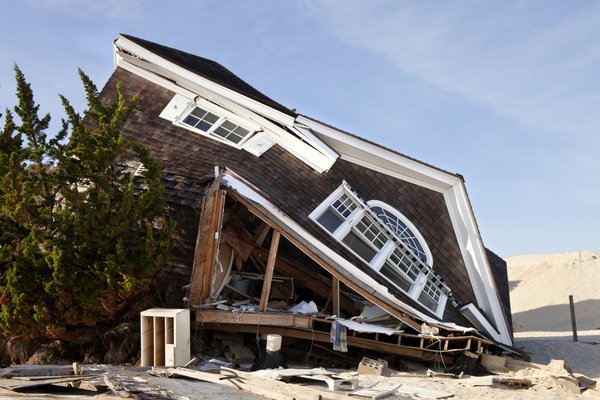
First the basement flooded. Then the premium doubled.
I got an email from a client in Des Plaines – let’s call her Mrs. Chen. She’d lived in her split-level for 22 years. Never a claim. Then a storm dumped six inches of rain in three hours, the nearby retention basin overflowed, and water pushed through her foundation wall. Not a sewer backup. Groundwater. Her policy didn’t cover it. She paid about $22,000 out of pocket for cleanup, new drywall, and a sump pump upgrade.
Two months later, her homeowners renewal arrived. Premium had gone from from about about $1,100 to roughly $2,300. No claims. No changes to the house. Just a new climate risk model that said her zip code now had a “high probability of pluvial flooding” – fancy words for rain-induced flooding.
Mrs. Chen called me, furious. “How can they double my rate when I already paid for the damage myself? I’m being punished for something that wasn’t even covered.” She wasn’t wrong. But the insurer wasn’t wrong either – from their perspective. The models had changed. And the models drive everything.
I spent years in underwriting watching this shift happen. When I started in the early 2010s, climate risk was a footnote. We looked at historical claims data: what happened in this zip code over the past ten years? That was our best predictor of future risk. Now, historical data is almost irrelevant. The past is no longer a reliable guide to the future. Instead, insurers use forward-looking climate models – scenarios of precipitation, wind, temperature, and flooding based on climate science. These models predict that parts of Illinois will see more intense rain events, more freeze-thaw cycles damaging roofs, and higher humidity leading to mold claims.
So rates are rising – not because your house is riskier today, but because the models say it will be riskier tomorrow.
The National Association of Insurance Commissioners has been studying this for years. A 2025 report found that climate risk modeling is causing “significant premium increases in areas not previously considered high risk” – including much of the Midwest. Insurers are also pulling back from coastal areas and wildfire zones, and they’re raising deductibles and reducing coverage options in inland areas that are seeing more severe weather.
Someone I worked with – let’s call him Ray – lived in a western suburb that never flooded. His home was on a hill. He had a new roof, new gutters, a working sump pump. Yet his homeowners premium went up about 18% in 2026. He asked his agent for an explanation. The agent said “your area’s storm severity index increased. The models show a higher probability of damaging hail and wind, even if your specific house hasn’t been hit.” Ray was frustrated. He asked me: “Should I switch carriers?” I said yes, but warned him that most carriers are using similar models now. The difference might be small.
We ran his numbers through the Home Insurance Valuator to get a baseline.
So what do you do when climate risk modeling drives up your premium? You can’t change the models. But you can change how you buy insurance.
First, ask your insurer if they offer mitigation discounts. Installing impact-resistant windows, reinforcing your roof deck, adding storm shutters, upgrading to a Class 4 impact-resistant shingle – these can lower your premium. Some carriers give about 10-25% discounts for certain upgrades. The catch is you have to provide proof. Keep receipts and photos.
Second, raise your wind/hail deductible. Many policies have separate deductibles for wind and hail – often about 1%, 2%, or even 5% of your dwelling coverage. If you’re willing to take a 2% deductible instead of 1%, your premium can drop significantly. But make sure you can afford that out-of-pocket. On a about $400k house, 2% is about $8,000. That’s real money.
Third, consider dropping coverage for perils that are very unlikely for your specific house. For example, if you’re not in a flood zone and have never flooded, you might skip flood insurance – but that’s risky. I advise keeping it if you have a basement. But you might drop earthquake coverage in Illinois – the risk is low.
Fourth, bundle your home and auto. Most carriers offer a 10-20% discount for bundling. In a rising rate environment, every discount helps.
Fifth, shop around every two years. Climate models vary by carrier. Some use proprietary models that might put less weight on certain risks. Get quotes from three or four carriers. I’ve seen people save about $400-600 a year by switching to a carrier with a different risk appetite.
Ray ended up switching to a regional carrier that offered a lower rate. He also raised his wind deductible from 1% to 2% and installed a few mitigation measures – roof clips and reinforced gutters. His new premium was about $1,750 – higher than his original about $1,100, but much lower than the $2,300 quote from his old carrier. He told me “I hate paying more, but at least I feel like I’m not being punished for nothing.”
Now, what about the broader trend? Climate risk modeling is not going away. As extreme weather events become more frequent and severe, insurers will continue to raise rates and restrict coverage. Some homeowners in high-risk areas may even find themselves unable to get traditional insurance – that’s already happening in Florida, California, and Louisiana. Illinois is not there yet, but areas near rivers and creeks are seeing tightening underwriting standards.
The Coverage Gap Calculator can help you identify if you have any climate-related coverage gaps.
Also check for “ordinance or law” coverage. If your home is damaged and needs to be rebuilt, you may have to meet new building codes – like higher elevation requirements in flood zones, or stronger roof attachments in wind zones. Ordinance coverage pays that extra cost. Without it, you pay the difference. That gap can be tens of thousands of dollars.
I remember a couple in Naperville – let’s call them the Mertzes. Their home was damaged by a severe hailstorm. The roof needed replacement. The city had adopted new impact-resistance standards since their house was built. Their policy had no ordinance coverage. They had to pay an extra about $9,000 out of pocket to bring the roof up to code. They added the endorsement the next year – cost about $45 annually.
Here’s the bottom line. Climate risk is real, and it’s hitting your wallet. You can’t stop the models. But you can take control of your coverage.
First, understand your home’s specific risks – flood, wind, hail, freeze, sewer backup. Use the Home Insurance Valuator to get a risk snapshot.
Second, make cost-effective mitigation upgrades. Roof clips, impact-resistant shingles, sump pump battery backup, backflow valves. Some of these pay for themselves in premium discounts within a few years.
Third, adjust your deductibles to balance premium savings against out-of-pocket risk.
Fourth, shop carriers regularly. Loyalty is not rewarded.
Fifth, close coverage gaps – especially sewer backup and ordinance law.
Climate change is not a political debate in insurance. It’s a math problem. The math says premiums will keep rising for many homeowners. But you can be smarter than average. You can shop, mitigate, and adjust. And you can avoid the worst gaps.
Mrs. Chen – the one whose premium doubled – she ended up staying with her carrier because no one else would write her at a better rate. But she added sewer backup coverage and raised her wind deductible. She also installed a battery backup for her sump pump. Her premium didn’t go down, but she said “at least I know I’m covered for the next storm.”
That’s the new reality. Not avoiding higher costs, but making sure you’re not destroyed by them.
P.S. Ray – the one who switched carriers – he sent me a photo of his new policy. He circled the wind/hail deductible – 2% – and wrote “hope I never need it.” Me too, Ray. Me too.
By Marcus, Chicago